





 AI Development
 Agentic AI Development
 AI-Product-Engineering
 Generative AI Development
 AI Chatbot Development
 RAG Development
 AI MCP Development
 n8n Automation Development
 AI Consulting



Piccosoft

Picco Labs
Picco AI
Piccosoft


Build the Right AI Foundation Before You Build the Product
Every business wants to build an AI-powered product, whether it's an AI assistant, an AI SaaS platform, or AI integrated into existing software. But success comes from solving business problems, organizing knowledge, and building the right foundation—not just choosing the latest AI model.

Suresh Sekar
Founder & CEOLorem ipsum dolor sit amet, consectetuer adipiscing elit. Aenean commodo ligula eget dolor. Aenean massa. Cum sociis natoque penatibus et magnis dis parturient montes, nascetur ridiculus mus.
Overview
Artificial Intelligence has become one of the biggest drivers of software innovation. Organizations across every industry are exploring AI to improve customer experiences, automate business processes, and create entirely new digital products.
Unfortunately, many AI initiatives never move beyond a proof of concept.
Some products look impressive during demonstrations but fail to solve real business problems. Others struggle with poor adoption because they were designed around technology instead of user needs.
Building a successful AI product requires much more than integrating a language model. It requires a clear understanding of business objectives, user workflows, enterprise knowledge, and long-term product strategy.
Business Reality
Many businesses begin their AI journey by asking:
"Which AI model should we use?"
While this is an important technical decision, it is rarely the first business decision.
The organizations that achieve the best results usually begin by asking different questions:
- Which business problem are we solving?
- Who will use this product every day?
- What information does the AI need to access?
- How will success be measured after deployment?
These questions define the success of the product long before any AI model is selected.
Common Challenges
Organizations building AI products often face similar challenges:
- Business requirements continue to evolve throughout development.
- Knowledge is distributed across documents, databases, and internal systems.
- AI is introduced before the underlying business process is fully understood.
- Different teams work with inconsistent information.
- Projects focus on technology rather than measurable business outcomes.
- Pilot projects are never designed for production-scale deployment.
These challenges increase development costs, delay product launches, and reduce long-term business value.
Our Perspective
At Picco AI, we believe AI should never be the starting point.
Business strategy should always come first.
Before designing any AI architecture, we recommend understanding how the organization operates, how information flows across departments, and where repetitive decision-making occurs.
Only after establishing this foundation should AI become part of the solution.
This approach creates products that are practical, scalable, and capable of delivering measurable business value.
Recommended Strategy
Our recommended implementation approach follows a structured roadmap.
Phase 1 — Business Discovery
Understand the business objectives, users, and operational challenges.
Phase 2 — Process Analysis
Map existing workflows and identify opportunities where AI can create measurable improvements.
Phase 3 — Knowledge Preparation
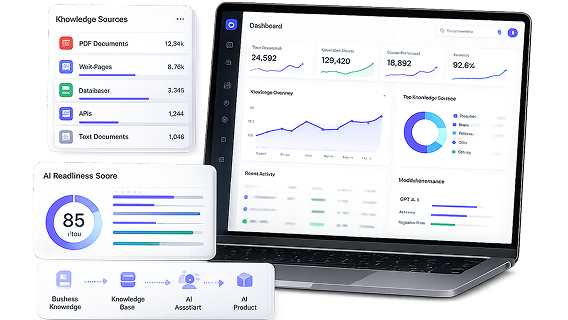
Collect, organize, and validate business knowledge from documents, databases, and enterprise systems.
Phase 4 — AI Architecture Design
Design the overall AI ecosystem, including knowledge platforms, enterprise integrations, security, and user experience.
Phase 5 — Pilot Development
Build a focused AI solution for a specific business use case and validate it with real users.
Phase 6 — Enterprise Rollout
Expand the solution across departments while continuously improving performance based on user feedback.
Implementation Roadmap
Lorem ipsum dolor sit amet, consectetuer adipiscing elit. Aenean commodo ligula eget dolor sociis natoque penatibus.

Lorem ipsum dolor sit amet, consectetuer adipiscing elit. Aenean commodo ligula eget dolor sociis natoque penatibus.

Lorem ipsum dolor sit amet, consectetuer adipiscing elit. Aenean commodo ligula eget dolor sociis natoque penatibus.

Lorem ipsum dolor sit amet, consectetuer adipiscing elit. Aenean commodo ligula eget dolor sociis natoque penatibus.

Lorem ipsum dolor sit amet, consectetuer adipiscing elit. Aenean commodo ligula eget dolor sociis natoque penatibus.

Lorem ipsum dolor sit amet, consectetuer adipiscing elit. Aenean commodo ligula eget dolor sociis natoque penatibus.

Lorem ipsum dolor sit amet, consectetuer adipiscing elit. Aenean commodo ligula eget dolor sociis natoque penatibus.

Lorem ipsum dolor sit amet, consectetuer adipiscing elit. Aenean commodo ligula eget dolor sociis natoque penatibus.
Lorem ipsum dolor sit amet, consectetuer adipiscing elit. Aenean commodo ligula eget dolor sociis natoque penatibus.
Expected Business Impact
Organizations that follow a structured AI implementation strategy often experience significant improvements:
- Faster product development cycles
- Higher user adoption
- Reduced implementation risk
- Better decision-making
- Easier integration with existing systems
- Improved scalability for future AI initiatives
- Greater return on technology investments
Most importantly, AI becomes a strategic business capability rather than an isolated software feature.
Final Recommendation
Artificial Intelligence should never be viewed as a shortcut to innovation.
Successful AI products are built on a strong understanding of business processes, trusted enterprise knowledge, and thoughtful product design.
Organizations that invest time in building the right foundation today will be better positioned to scale AI across every department tomorrow.
The future belongs not to the companies with the newest AI models, but to the organizations that apply AI to solve meaningful business problems.
Ready to Build Your AI Product?
Whether you're planning an AI-powered SaaS platform, an enterprise AI application, or a custom AI solution tailored to your business, our team can help you design, develop, and deploy a scalable AI product from strategy to production.
